
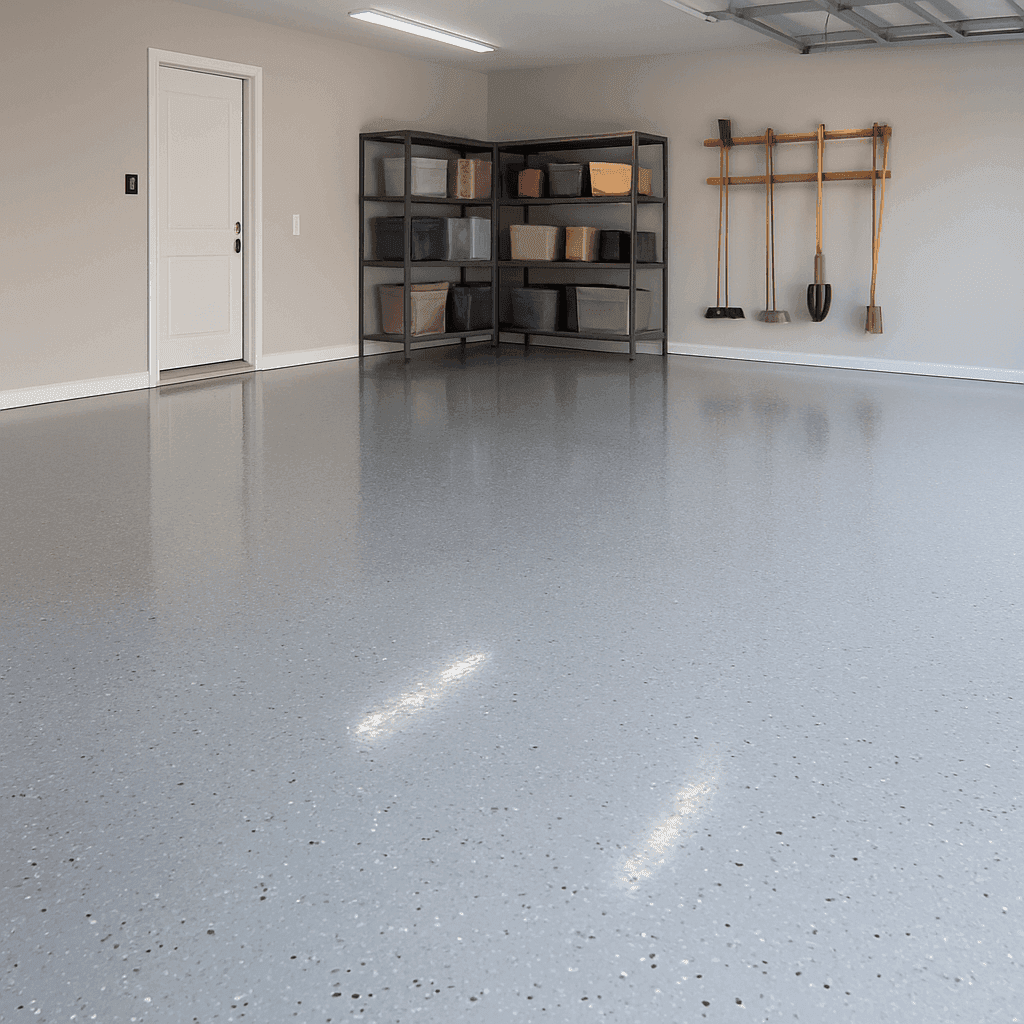
If you've been thinking about giving your garage floor an upgrade, epoxy coating is probably already on your radar. It looks great, it's durable, and it instantly makes a garage feel more like usable living space rather than a catch-all storage room. But if you're in the greater Houston area — Katy, Cypress, Sugar Land, The Woodlands, or anywhere else in our region — there are some important things to understand before you commit to a coating system.
Houston's climate is genuinely tough on epoxy. High humidity, extreme heat, and temperature swings between air-conditioned interiors and summer garage air all affect how epoxy bonds, cures, and holds up over time. Done right, garage epoxy in Houston looks beautiful and lasts for years. Done wrong — or with the wrong product — it peels, bubbles, and chips within a season. Here's what you need to know.
What Is Garage Epoxy Coating?
Epoxy floor coating is a two-part system — a resin and a hardener — that, when mixed and applied to concrete, chemically bonds to form a hard, durable, semi-gloss surface. It's different from regular floor paint, which simply sits on top of concrete without bonding to it chemically. That chemical bond is what makes epoxy significantly more durable than standard paint for garage applications. Most residential epoxy systems consist of:
- A primer or etching step to open the concrete pores
- A base coat — the primary epoxy layer
- Color chips or flakes (optional, but popular) broadcast into the wet base coat for grip and appearance
- A topcoat or sealer for UV protection, stain resistance, and sheen level
The full system — when properly installed — creates a surface that resists oil, chemicals, tire marks, and heavy traffic while being easy to clean with a mop or hose.
Why Houston's Climate Makes Epoxy Tricky
Most epoxy application problems we see in Houston come down to one of two things: moisture in the concrete, or temperature conditions during application. Our climate creates both challenges simultaneously.
Moisture in the Slab
Houston sits on clay-heavy soil with a high water table in many areas. Concrete slabs here are frequently dealing with moisture vapor transmission — water vapor rising up through the slab from the ground below. You may never see standing water, but if moisture vapor levels are high at the time of application, epoxy won't bond properly to the concrete. The result is delamination: the coating lifts away in sheets or bubbles from underneath.
Before any epoxy application in Houston, moisture vapor emission testing should be part of the process. A calcium chloride test or an in-situ RH (relative humidity) probe test measures what's happening inside the slab, not just at the surface. Skipping this step is a gamble that often doesn't pay off — especially in neighborhoods with known drainage challenges or in homes built on filled lots.
Temperature and Humidity During Application
Epoxy is temperature-sensitive during both application and cure. Most epoxy systems call for application temperatures between 50°F and 90°F, with surface and ambient temperatures within a few degrees of each other. In Houston summers, garage air can exceed 100°F by mid-morning. Concrete surface temperatures — which absorb radiant heat — can run 10 to 20 degrees higher than ambient air.
When epoxy is applied to a surface that's too hot, it sets too quickly. You lose working time, the product doesn't level properly, and adhesion is compromised. Experienced installers in Houston typically schedule epoxy work in early morning hours during summer months, when the slab is cooler, or they wait for the brief mild weather windows in spring and fall. High humidity during cure — above 85% relative humidity — can also cause problems, particularly with moisture-sensitive topcoat systems.
Epoxy vs. Polyurea vs. Polyaspartic: Which Is Right for Houston?
The term "garage epoxy" is often used loosely to describe several different coating systems. Here's a quick breakdown of the main options and how they perform in Houston conditions:
| System | Strengths | In Houston | Best For |
|---|---|---|---|
| Traditional Epoxy | Excellent chemical & abrasion resistance | Temperature-sensitive; slower cure in heat | Cooler-month installs, thicker build priority |
| Polyurea | Flexible, faster cure, better UV resistance | Handles wider temp range; tolerates minor slab movement | Faster return to service, UV exposure |
| Polyaspartic | One-day install, fast cure, excellent UV stability | Cures well in warm temps; minimal downtime | Hot, UV-intense Houston garages |
A quality professional installation will often combine systems — an epoxy base coat for build and adhesion, with a polyaspartic or polyurea topcoat for UV protection and cure speed. That hybrid approach plays to the strengths of each chemistry.
Surface Prep: The Step That Determines Everything
If there's one thing to take away from this article, it's this: the quality of a garage epoxy installation is almost entirely determined by surface preparation. The best coating system in the world will fail on improperly prepared concrete. It's the same prep-first principle that determines whether exterior paint lasts in our climate.
Mechanical Grinding vs. Acid Etching
There are two primary methods for opening up concrete before epoxy application: acid etching and mechanical diamond grinding.
Acid etchinguses a muriatic or phosphoric acid solution to chemically roughen the concrete surface and open the pores. It's a lower-cost approach and can be done without special equipment. However, it has limitations — it doesn't remove concrete laitance (the weak surface layer on new slabs), it doesn't work well on troweled-smooth or previously sealed concrete, and it leaves residue that must be completely neutralized and rinsed away. In humid Houston conditions, managing the acid and rinse process can be tricky.
Mechanical grinding uses diamond cup wheels to physically abrade the concrete surface to the correct profile. This is the professional standard for residential and commercial garage floors. It removes laitance, opens the surface uniformly, and works on all concrete surface conditions including previously coated, sealed, or contaminated slabs. For Houston homeowners investing in a quality coating system, mechanical grinding is the right choice. The difference in adhesion and long-term performance is significant.
Crack and Spall Repair
Existing cracks, chips, or surface damage in your concrete should be repaired before coating. Small hairline cracks (common in Houston slabs that experience soil movement) can be filled with polyurea crack filler. Larger structural cracks require evaluation before coating — epoxy is not a structural repair product and won't hold across active cracks.
Oil stains are another common issue in Houston garages. Old motor oil that has soaked into concrete over years of parking can prevent epoxy adhesion in those spots. Heavy oil contamination typically requires cleaning with a degreaser followed by grinding to remove the stained layer of concrete entirely. Coating over oil stains without proper treatment will result in those specific spots failing first.
What Does Garage Epoxy Cost in Houston?
Pricing for professional garage epoxy installation in the Houston area varies based on system type, garage size, surface condition, and prep requirements. As a general reference point:
- Single-car garage (approximately 200–250 sq ft): $800–$1,500 for a professional-grade system
- Two-car garage (approximately 400–500 sq ft): $1,500–$3,000
- Three-car garage (600+ sq ft): $2,500–$4,500+
These ranges reflect professional installation with proper prep — mechanical grinding, moisture testing, and a multi-coat system. DIY kits from home improvement stores run significantly less in materials but carry significant failure risk if the prep isn't done correctly. Stripping a failed DIY epoxy coating from concrete is labor-intensive and adds cost to any subsequent professional installation. If budget is a concern, ask about financing options rather than cutting corners on prep.
How Long Does Garage Epoxy Last in Houston?
A professionally installed, properly prepared epoxy or polyaspartic system in a Houston garage can last 10 to 20 years with reasonable maintenance. Factors that affect longevity include:
- UV exposure: Garages with significant sunlight exposure fade and yellow faster with standard epoxy. UV-stable topcoats (polyaspartic or polyurea) perform significantly better.
- Vehicle traffic:Hot tire pickup — where a car's tires are hot from driving and pull the epoxy surface when it parks — is a known failure mode with certain epoxy systems. Quality polyaspartic topcoats are much more resistant.
- Chemical exposure: Oil drips, fertilizer, and pool chemicals (common in Houston homes with outdoor spaces) can damage certain coating systems over time. Regular cleaning prevents most issues.
- Maintenance: Epoxy is easy to maintain — a regular sweep and occasional damp mop is all most floors need. Avoid abrasive scrubbing pads on glossy topcoats.
Signs It's Time to Replace or Recoat Your Garage Floor
If your garage has an existing coating that's showing wear, here's how to tell what it needs:
- Light surface scratching or dullness — The topcoat is wearing. A fresh topcoat layer can restore appearance and protection without a full recoat.
- Peeling or delamination in spots — The adhesion has failed in those areas. Spot repairs are possible, but if delamination is widespread, a full removal and reinstallation is usually the right call.
- Bubbling or blistering — Almost always a moisture issue. The coating needs to be removed, the moisture problem addressed, and the floor recoated.
- Cracking that follows the concrete below — The slab is moving. This needs evaluation to determine whether the movement is ongoing (a structural concern) or historical and stable.
What to Look for When Hiring a Garage Epoxy Contractor in Houston
The garage floor coating industry has grown quickly, and like any trade, quality varies. When evaluating contractors in the Houston area:
- Ask specifically whether they use mechanical grinding or acid etching for prep. A contractor who only offers acid etching is limiting the quality of their work from the start.
- Ask about moisture testing. Any contractor skipping this step in Houston is cutting corners.
- Ask about the specific products they use. Generic "epoxy" answers aren't specific enough — quality contractors can name their coating system and explain why they use it.
- Ask for references from Houston-area projects — specifically how those floors have held up over time, not just how they looked when newly installed.
- Look at their process timeline. A one-day install on a standard two-car garage using a full grind-and-coat system with multiple layers should raise questions about whether proper dry time between coats is being observed.
Pair Garage Epoxy With a Clean Foundation
Before any epoxy installation, the surrounding walls and any trim or step areas in your garage are worth evaluating as well. If you're investing in a quality floor, it's a natural time to freshen the painted surfaces and concrete walls that frame the space. Houston Superior Painting handles interior garage painting alongside our other services — interior painting and pressure washing are commonly paired with garage floor prep work. A clean floor with fresh paint on the walls transforms a utilitarian garage into a functional, finished part of your home.
Ready to Transform Your Houston Garage?
Whether you're planning garage epoxy for your home in Katy, Cypress, Sugar Land, The Woodlands, or anywhere in the greater Houston area, the foundation of a great result is the same: proper prep, the right coating system for our climate, and an installer who knows Houston's specific challenges. Learn more about our garage epoxy coating service, or contact us for a free estimate.
Frequently Asked Questions
How much does garage epoxy cost in Houston TX?
Professional garage epoxy installation in Houston typically runs $800–$1,500 for a single-car garage, $1,500–$3,000 for a two-car garage, and $2,500–$4,500+ for a three-car garage. These ranges reflect proper prep including mechanical grinding, moisture testing, and a multi-coat system. DIY kits cost less in materials but carry significant failure risk if prep is done incorrectly.
Why does epoxy fail in Houston garages?
The two most common causes of epoxy failure in Houston are moisture vapor transmission through the concrete slab and improper application temperatures. Houston's clay-heavy soil and high water table push moisture vapor up through slabs, and summer surface temperatures can exceed 120°F. Without moisture testing and proper temperature scheduling, epoxy delaminates, bubbles, or peels.
Is polyaspartic or epoxy better for a Houston garage?
For Houston's hot, UV-intense climate, polyaspartic systems often outperform traditional epoxy because they cure quickly even in warm temperatures, resist UV yellowing, and handle hot tire pickup better. Many quality installers use a hybrid approach — an epoxy base coat for build and adhesion with a polyaspartic topcoat for UV protection and fast cure.
How long does garage epoxy last in Houston?
A professionally installed, properly prepared epoxy or polyaspartic system in a Houston garage can last 10 to 20 years with reasonable maintenance. Longevity depends on UV exposure, vehicle traffic, chemical exposure, and routine cleaning. UV-stable topcoats and proper surface prep are the biggest factors in long-term performance.
Should garage epoxy use grinding or acid etching for prep?
Mechanical diamond grinding is the professional standard and the right choice for Houston garages. It removes concrete laitance, opens the surface uniformly, and works on all concrete conditions including previously sealed or contaminated slabs. Acid etching is lower-cost but doesn't remove laitance, struggles on smooth or sealed concrete, and leaves residue that must be neutralized.